
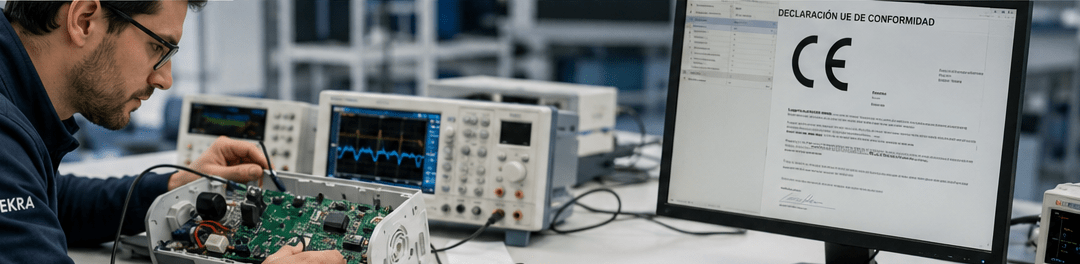
Introduction
Electrical and electronic products may be subject to different European requirements before being placed on the market in the European Economic Area. The manufacturer must demonstrate that the product complies with applicable legislation through testing, technical documentation, conformity assessment, and an EU Declaration of Conformity.
CE marking for electrical and electronic products involves more than simply placing the CE symbol on the product. It involves identifying which requirements apply, verifying whether laboratory testing is necessary, preparing the technical file, and maintaining evidence to support conformity.
In this article we explain which electrical and electronic products may need CE Marking , which directives or regulations are most common, what tests may be necessary and what documentation the manufacturer must prepare before marketing the product.
Table of Contents
1. Which electrical and electronic products may require CE marking
2. What requirements may apply to electrical and electronic products
3. Standard directives and regulations
4. Standard tests for electrical and electronic products
5. Required technical documentation
6. EU Declaration of Conformity and Labelling
7. Is a notified body required for electrical and electronic products?
8. Common errors in electrical and electronic products
9. Checklist before marketing an electrical or electronic product
10. How DEKRA can help you
11. Frequently Asked Questions about CE Marking for Electrical and Electronic Products
1. Which electrical and electronic products may require CE marking
Many electrical and electronic products sold in Europe must bear the CE marking when they are covered by European legislation that requires it . The obligation depends on the type of product, its intended use, its technical characteristics, and the market in which it will be sold (the European Union in this case).
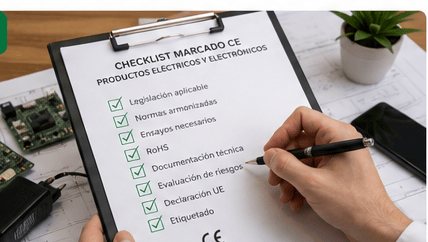
Within this category you can find products such as:
- electrical equipment for domestic use;
- consumer electronics;
- industrial devices with electrical components;
- power supplies and chargers;
- luminaires and lighting products;
- computer equipment;
- IoT devices;
- products with WiFi, Bluetooth or other wireless technologies;
- measuring equipment;
- control and automation systems;
- medical equipment;
- in vitro equipment;
- elevators;
- equipment for railway or maritime applications;
- toys;
- drones;
- electric meters;
- components or equipment integrated into larger installations.
Not all products are subject to exactly the same requirements . For example, a charger, a light fixture, an industrial sensor, or a Bluetooth-connected device may require different assessments even though they are all electrical or electronic products.
Therefore, the first step should not only be to ask if the product "has CE marking", but to identify which European legislation applies and what technical evidence is needed to demonstrate conformity.
2. What requirements may apply to electrical and electronic products
CE marking of electrical and electronic products can involve various types of requirements . Some are related to essential health and safety requirements, others to the essential functioning of the product, the use of the radio spectrum, or the presence of restricted substances.
The most common requirements are usually related to:
- electrical safety;
- electromagnetic compatibility;
- radio frequency and wireless connectivity;
- restricted substances;
- labeling and instructions;
- product traceability;
- conformity assessment scheme;
- EU Declaration of Conformity.
A single product may be covered by more than one directive or regulation . For example, a connected electronic device may have requirements for electromagnetic compatibility, radio frequency, electrical safety, and RoHS (restricted substances).
That's why it's important to analyze the product as a whole, not just its main functions.
3. Standard directives and regulations
Electrical and electronic products may be subject to various European directives or regulations . The specific application depends on the product, its supply voltage, functions, integrated technology, and intended use.
3.1 Low voltage and electrical safety
Electrical safety seeks to reduce risks related to electric shocks, overheating, fires, insulation, protection against dangerous contacts and abnormal operating conditions, among others.
It is relevant for mains-powered products, battery-powered equipment, power supplies, chargers, industrial equipment, lighting products, and other electrical devices.
In this context, the manufacturer must demonstrate that the product is safe under normal and foreseeable conditions of misuse.
3.2 Electromagnetic Compatibility (EMC)
Electromagnetic compatibility, or EMC, assesses whether a product can function properly in its electromagnetic environment and whether it generates excessive interference to other equipment.
In electrical and electronic products, EMC requirements are especially important because a device can emit disturbances or be affected by external signals.
EMC assessment typically considers two aspects:
- electromagnetic emissions, that is, disturbances generated by the product;
- electromagnetic immunity, that is, the product's ability to withstand external disturbances.
3.3 Radioelectric Equipment NETWORK
When a product incorporates wireless technologies, such as WiFi, Bluetooth, radio, NFC, UWB or other radio communications, it is subject to specific requirements for radio equipment.
In these cases, in addition to safety and EMC, aspects such as the following can be evaluated:
- efficient use of the spectrum;
- transmission power;
- unwanted emissions;
- receptor behavior;
- coexistence with other teams;
- exposure to radiofrequency, when applicable.
This affects many IoT devices, wearables, consumer electronics, connected industrial equipment, and smart home products.
3.4 RoHS and restricted substances
Electrical and electronic products may also be subject to restrictions on certain hazardous substances. RoHS sets limits for substances present in materials, components, solder, cables, coatings, and circuit boards , among other things.
For manufacturers, RoHS compliance is not limited to obtaining a supplier declaration . It requires documented evidence, material control, component traceability, and analytical testing.
3.5 Other requirements depending on the product
In addition to the above requirements, some products may be subject to specific regulations depending on their use, sector, or characteristics.
For example:
- lighting products;
- measuring equipment;
- electronic medical devices;
- industrial equipment;
- in vitro equipment;
- equipment used in specific environments (ATEX);
- products integrated into more complex machines or systems.
Therefore, the initial product analysis is key to avoiding errors in the selection of requirements.
4. Standard tests for electrical and electronic products
Testing provides objective evidence of product compliance. While not all products require the same tests , technical testing is typically needed for electrical and electronic products to support the conformity assessment.
4.1 EMC Trials
EMC testing allows verification that the product does not generate excessive interference and that it can function correctly in the face of reasonable external disturbances, both from the radiated and conducted point of view.
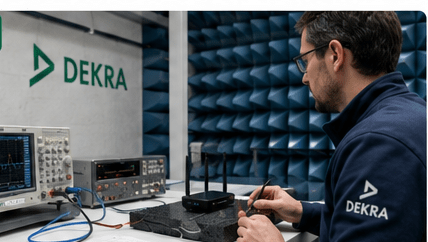
Some critical parts for EMC trials are:
- printed circuit board;
- power supplies;
- cabling;
- connectors;
- insufficient filtering;
- shielding;
- component arrangement;
- operating modes not considered in the test.
Conducting these tests during the development phase can help detect problems before the product reaches the market.
4.2 Electrical safety tests
Electrical safety tests help to verify that the product does not present unacceptable risks to the user, pets and the environment.
They may include checks on:
- insulation (dielectric strength, partial discharges, etc.);
- leakage currents;
- heating;
- protection against electric shock;
- safety distances;
- mechanical stability;
- protection against radiation;
- construction requirements;
- review of critical components;
- behavior in the face of foreseeable failures;
- Power supply check (safety of chargers, batteries or AC/DC adapters).
These tests are especially important when the product is connected to the electrical grid, incorporates internal power (batteries) or can be handled by non-specialized users.
4.3 Radiofrequency Tests
When the product incorporates wireless connectivity, radio frequency testing allows verification that the equipment uses the spectrum correctly and meets applicable requirements.
Aspects such as the following can be evaluated:
- transmitted power;
- bandwidth;
- unwanted emissions;
- receptor sensitivity;
- coexistence;
- antenna behavior;
- radiofrequency exposure for people;
- operation in the intended channels or bands.
A change in antenna, radio module, casing, or firmware can affect the results, so it is important to evaluate the final version of the product.
4.4 RoHS Testing
RoHS testing is used to verify the presence or concentration of restricted substances in materials or components.
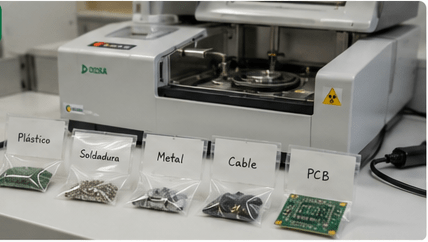
They can be applied to:
- welding;
- cables;
- plastics;
- coatings;
- electronic boards;
- connectors;
- casings;
- others.
In products with an extensive bill of materials (many suppliers or imported components), these tests are essential to strengthen technical documentation and reduce the risk of non-compliance.
4.5 Environmental and reliability testing
In some electrical and electronic products, it is necessary to check how they behave under foreseeable environmental conditions and to know their failure rate or expected life cycle.
Some examples of typical essays in this area are:
- heat;
- cold;
- temperature variation;
- thermal shock;
- humid heat;
- altitude simulation,
- simulated vibration (sine, random, etc.);
- mechanical or classic shock;
- IP rating/NEMA code (dust, water, sand, …)
- corrosion (salt spray, acetic spray, etc.);
- hail;
- solar radiation, ultraviolet (UV).
These tests may be associated with regulatory requirements, customer specifications, or actual product usage conditions.
5. Required technical documentation
Technical documentation is an essential part of CE Marking . It demonstrates that the product has been properly assessed and that sufficient evidence exists to support its conformity.
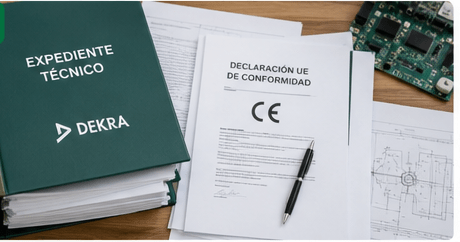
For electrical and electronic products, the technical file may include:
- Product overview;
- models, references and variants covered;
- intended use;
- Product photographs;
- electrical schematics;
- block diagrams;
- list of critical components;
- description of the software or firmware, if applicable;
- applicable European legislation;
- technical standards used;
- risk assessment;
- test reports;
- certificates or component declarations;
- RoHS documentation;
- manuals and instructions;
- safety warnings;
- labeled;
- software life cycle;
The technical documentation must accurately reflect the actual product being marketed. If a prototype is tested, but the design, power supply, radio module, casing, or firmware are subsequently modified, it is necessary to verify whether the documentation remains valid.
6. EU Declaration of Conformity and Labelling
The EU Declaration of Conformity is the document by which the manufacturer declares that the product complies with applicable European legislation.
In electrical and electronic products, this declaration must be aligned with the technical file, test reports, standards used and the final product marketed.
Special attention should be paid to:
- product identification;
- manufacturer's name and address;
- applicable directives or regulations;
- harmonized standards used;
- data of notified body, if applicable;
- person authorized to sign;
- date and place of issue;
- consistency with labeling and technical documentation (traceability).
The labeling must also be carefully checked. The CE marking must be affixed visibly, legibly, and indelibly, as required by applicable legislation . In addition, other information such as model, batch, serial number, manufacturer, warnings, or specific product details may be required.
7. Is a notified body required for electrical and electronic products?
Not all electrical and electronic products require the intervention of a notified body. In many cases, the manufacturer can follow an internal assessment procedure , provided that applicable legislation allows it and sufficient evidence is available to demonstrate conformity.
However, it may be necessary to review the intervention of a notified body when:
- applicable legislation requires it;
- the product belongs to a specific category;
- Harmonized standards are not fully applied;
- The conformity assessment procedure requires an authorized third party;
- There are particular risk or safety requirements (not addressed in current legislation);
- The product incorporates technologies or functions that require further evaluation.
The decision must be documented within the technical file. It is not enough to assume that a notified body is not required; it must be justified according to the product and applicable legislation.
8. Common errors in electrical and electronic products
In CE Marking projects for electrical and electronic products, there are errors that can cause delays, additional costs, or problems in marketing.
X Failure to identify all applicable directives
A product may be covered by more than one set of regulations. For example, a connected electronic device may require EMC, radio frequency, electrical safety, and RoHS testing.
X Test a different version of the final product
If the product changes after the trial, the results may not cover the version that will be marketed.
X Do not consider accessories or power supplies
Chargers, cables, antennas, adapters, and accessories may affect product conformity.
Use component documentation as if it covered the entire product
Component certificates or reports are helpful and sometimes necessary, but they never replace the evaluation of the final product.
X Not checking the user manual
The instructions, warnings, installation conditions and limitations of use form part of the product's conformity.
X Declare outdated standards
Technical standards are updated periodically. It is advisable to check if the versions applied are still valid to demonstrate compliance.
X Do not update documentation after design changes
Changes in hardware, software, firmware, antenna, casing, materials, or suppliers may affect the technical file.
9. Checklist before marketing an electrical or electronic product
Before affixing the CE marking and placing an electrical or electronic product on the market, it is advisable to check:
- type of product and intended use;
- target market;
- applicable directives or regulations;
- technical standards used;
- need for EMC testing, electrical safety, radio frequency, etc.;
- RoHS compliance;
- technical documentation available;
- risk assessment;
- test reports;
- user manual;
- warnings and instructions;
- labeled;
- traceability in manufacturing;
- EU Declaration of Conformity;
- need or not of intervention by a notified body;
- design changes;
- consistency between product, tests and documentation.
This checklist should be adapted to each product. Not all electrical and electronic devices have the same requirements, but all must have sufficient evidence to demonstrate compliance with applicable legislation.
10. How DEKRA can help you
DEKRA assists manufacturers, importers, authorized representatives and distributors in CE Marking processes for electrical and electronic products, from identifying requirements to conducting tests and reviewing technical documentation.

The support may include:
- initial product analysis;
- identification of applicable directives, regulations and standards;
- definition of the test plan;
- EMC trials;
- electrical safety tests;
- radiofrequency tests;
- RoHS testing;
- environmental or reliability tests;
- review of technical reports;
- support in the preparation of the technical file;
- EU Declaration of Conformity review;
- guidance on labeling
- Verification of product traceability in the product manufacturing process
- certification in third countries (USA, Canada, CB Scheme, UL standard, …) .
If you are unsure which requirements apply to your electrical or electronic product, you can use the interactive CE Marking guide or consult your case with an expert.
11. Frequently Asked Questions about CE Marking for Electrical and Electronic Products
Not all electrical and electronic products are subject to the same requirements, but many of them may need CE Marking if they are covered by European legislation that requires it.
It depends on the product, but EMC, electrical safety, radio frequency, RoHS, environmental or reliability tests may be required.
Yes. Products with wireless connectivity may be subject to specific radio equipment requirements, in addition to EMC, safety, and RoHS.
Not always. Component reports or certificates can help, but the manufacturer must demonstrate the conformity of the final product.
You must prepare technical documentation to support the conformity assessment, including product description, applicable standards, test reports, risk assessment, instructions, labelling and EU Declaration of Conformity.
Testing may need to be repeated or expanded if the design, a critical component, the power supply, the antenna, the firmware, the housing, or the intended use changes.
Not always. It depends on the applicable legislation, the conformity assessment procedure, and the product characteristics.
Do you need to prepare the CE Marking for your electrical or electronic product?
Our team helps you identify applicable requirements, define necessary tests, and review technical documentation to move forward confidently before marketing your product in Europe.